Calling timeouts in the NBA
How much of a season disappears into timeouts? I dug into 2015-16 play-by-play to map when coaches stop the game, who stops it most, and whether a timeout actually halts a run.
I miss basketball. The 2015-16 season was arguably one of the best of all time — the utter dominance of Steph and the 73-win Warriors that ended, somehow, in LeBron's redemption story. So when I got up to grab a snack during yet another fried-chicken ad, I started wondering how much of that beautiful season I'd actually spent watching coaches stop it.
In the NBA, teams are allowed seven timeouts, each 1 minute 15 seconds. A timeout can only be requested by a player in the game or the head coach, and only when the ball is dead or in control of the team making the request.
Timeout stats aren't common in box scores, but I found play-by-play data here and decided to count them myself.
Across the 2015-16 regular season — 1,230 games — there were 16,508 timeouts. Once you set aside the league's automatic TV timeouts (which the data doesn't charge to anyone), teams called slightly more on the road (7,210) than at home (7,041).
How much does each team stop the game?
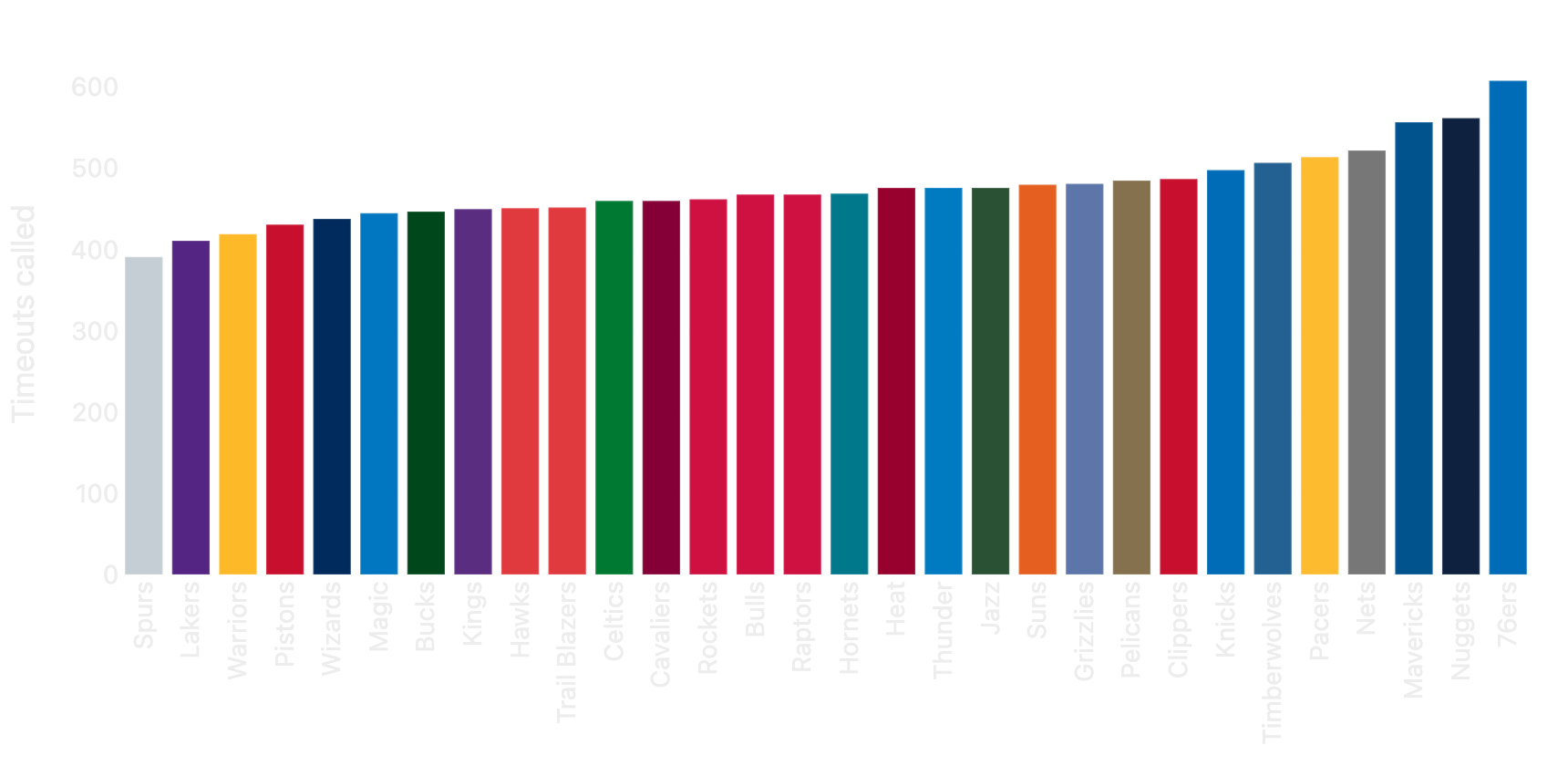
The first thing that jumped out was how much teams vary. At the thrifty end sit Gregg Popovich's Spurs, with a league-low 391 — no shock to anyone who's watched Pop wave off a stoppage and let his guys play through a rough patch. At the other extreme, Brett Brown's rebuilding 76ers called the most, 608. Coaches really do treat timeouts as a matter of personality; in this Sports Illustrated piece several of them talk through their philosophies — including the immortal complaint that all the voluntary stoppages "ate into my dinner time." I feel that.
When do timeouts happen?
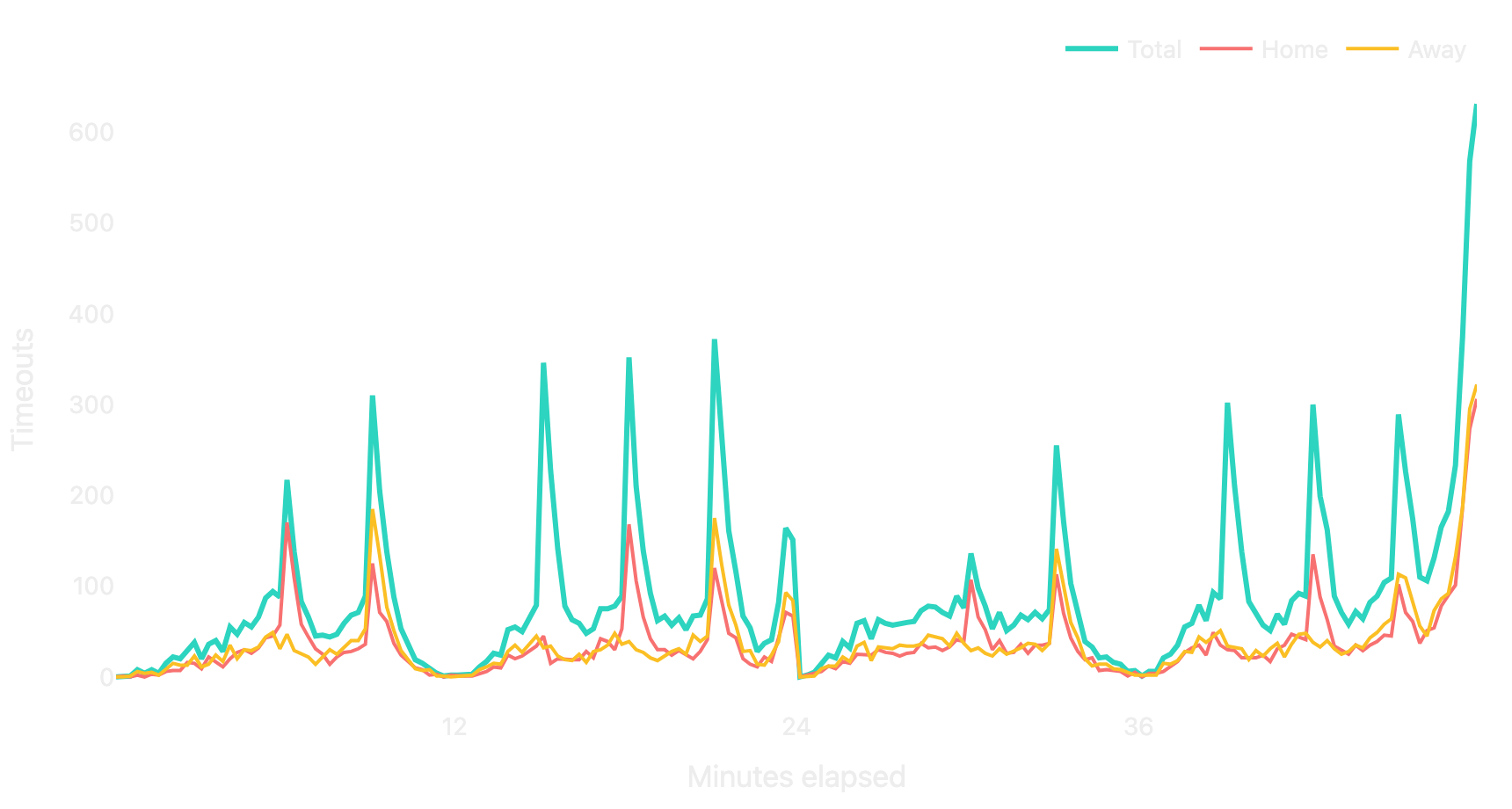
We all know the end of a close game can be excruciating thanks to timeout calls, but I wondered how they're spread across the rest of the game.

The pattern is strikingly regular for the first three quarters, then everything changes in the fourth. Each quarter has two clean peaks, and they line up with the league's mandatory TV timeouts. From the rulebook:
"There must be two mandatory timeouts in each period. If neither team has taken a timeout prior to 6:59 of the period, it shall be mandatory for the Official Scorer to take it. If no subsequent timeouts are taken prior to 2:59, it shall be mandatory to take it."
Those automatic breaks aren't charged to a team in this data, which is why the league-wide Total line spikes far higher than the Home and Away traces — those only carry the voluntary stoppages.
The fourth quarter is a different animal. The rulebook limits each team to two timeouts after the three-minute mark, so coaches start spending them early to avoid wasting any — and then the very end of a close game is, predictably, timeout galore.
What's the score when coaches intervene?
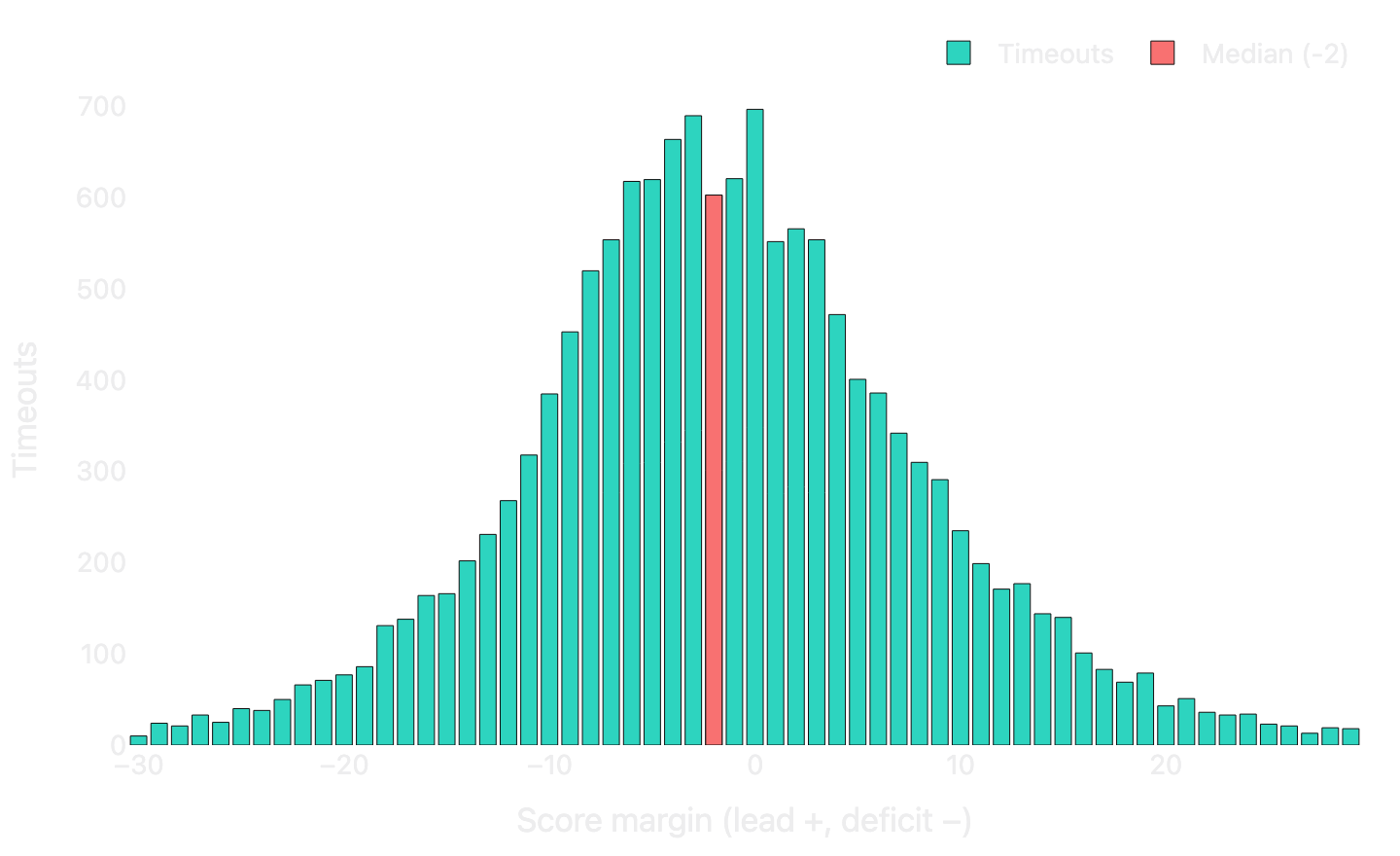
Not all timeouts are the same. Next I looked at the score differential at the moment of every timeout.

It's shifted slightly to the negative side. The red bar marks the median (−2): half of all timeouts were called when the team was losing by more than two points.
But teams ask for timeouts not only when they're losing, but when they're losing advantage. If your +20 lead gets cut to +10, you might call one — and you're still up 10, so that proximal cause is invisible in the graph above. To see it, I tracked the score in a tight window around each timeout.
Do timeouts actually stop a run?
Below is the calling team's net point swing in the 90 seconds around a timeout, with zero anchored at the start of the window — so a line sliding down means the team is being outscored. Use the dropdown to swap the league average for any single team.
There it is. In the minute and a half leading up to a timeout, the calling team bleeds about two points of margin — they're getting outscored, which is exactly why the coach stands up. The moment the whistle blows, the slide stops: after the timeout the line flattens out and ticks back up. Stop-the-bleeding timeouts are real.
Of course, momentum isn't the only reason coaches call them — substitutions, injuries, drawing up a late-game possession, or simply protecting their dinner time all count too.
Which teams let it ride?
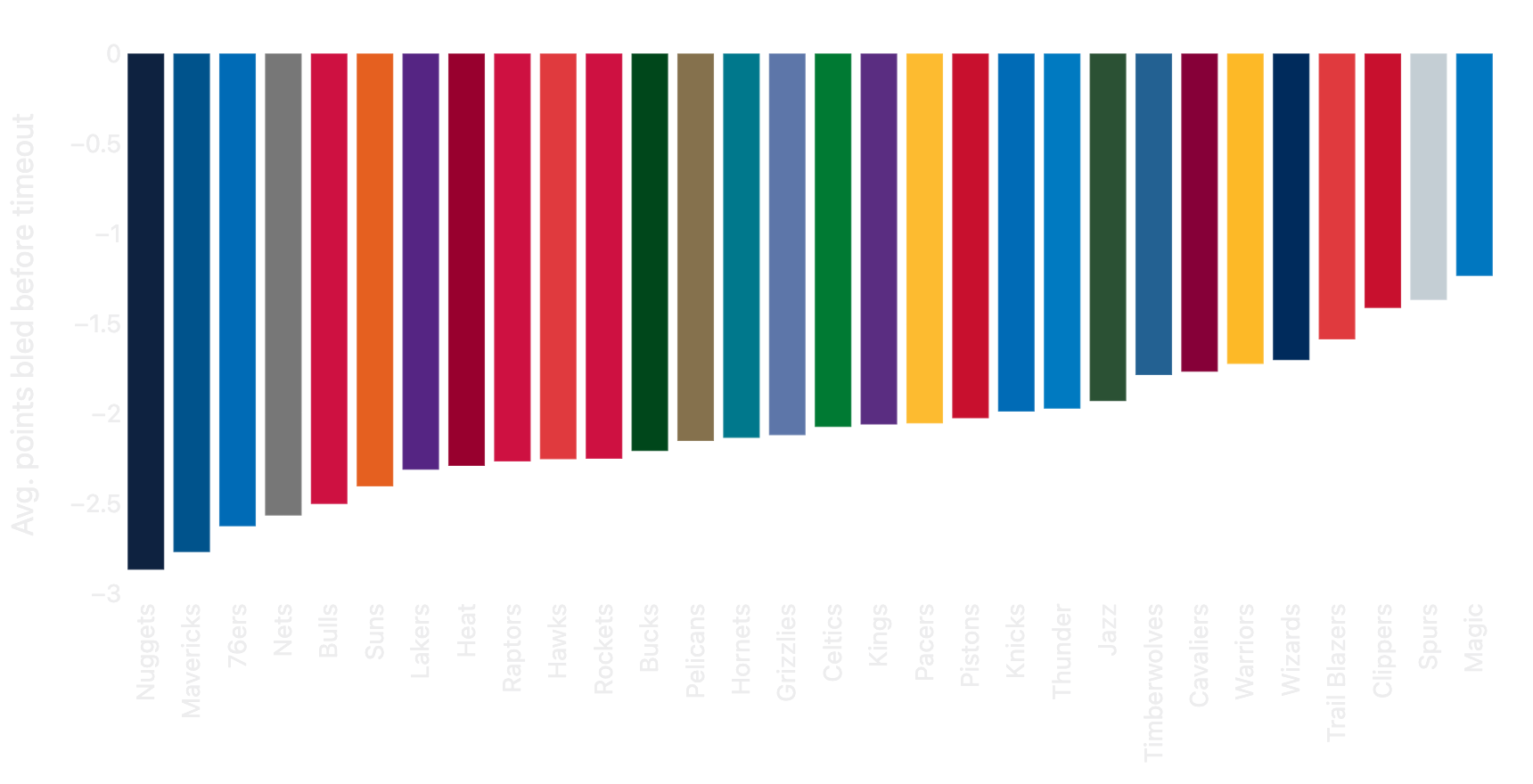
That league-average curve hides a lot of personality, and two questions fall straight out of it once you split it by team. The first: how far does a team let a run go before calling a timeout? That's just how deep the slide is at the moment the whistle blows.

The Nuggets had the slowest trigger in the league — they'd let a run reach nearly three points before stopping it — while the Magic were the twitchiest, reaching for a timeout after barely a point of bleeding. Whether patience is wisdom or stubbornness, I'll leave to you.
...and whose timeouts actually work?
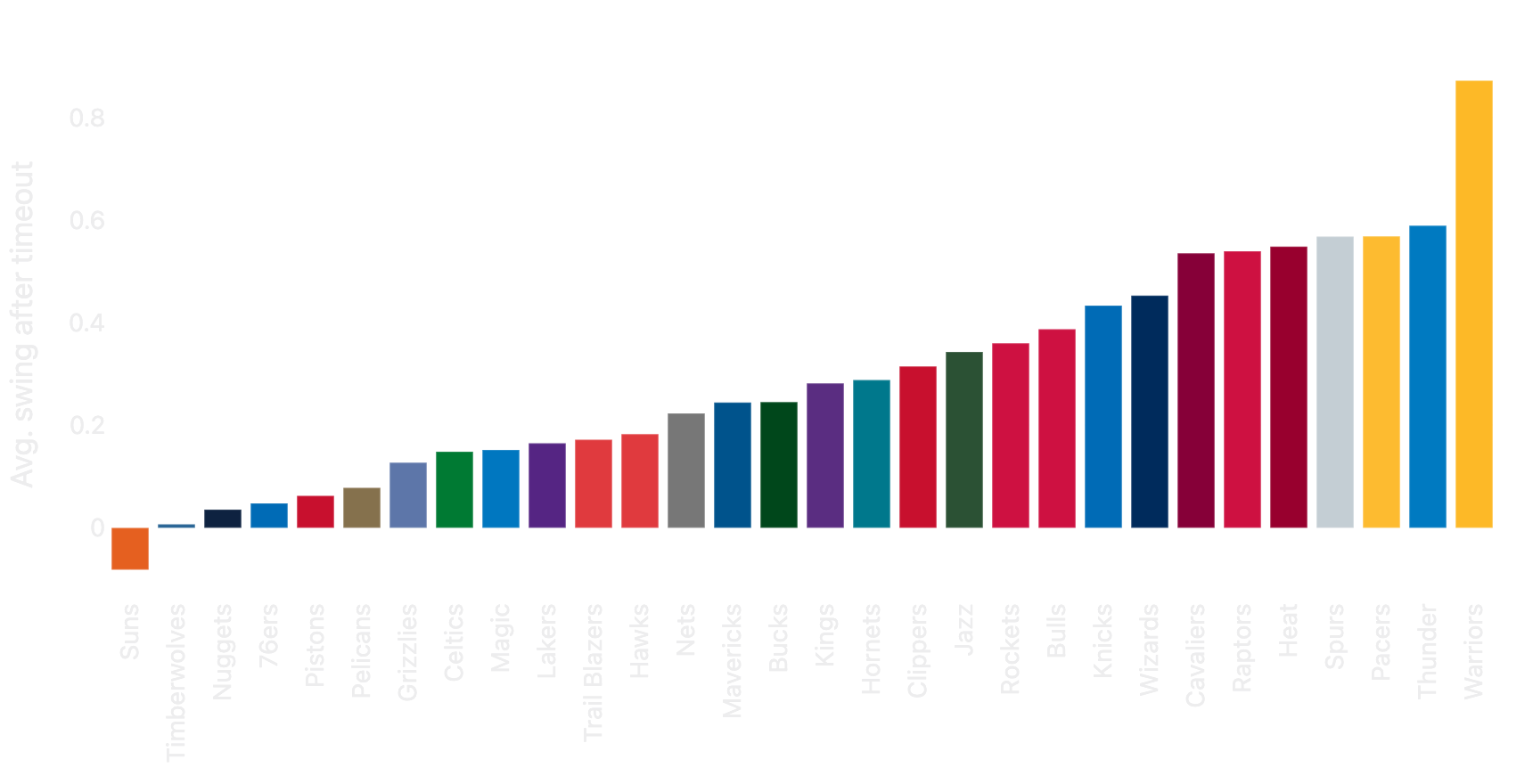
The second question is the real test: once the timeout is called, does the run actually stop? This compares the score swing in the 90 seconds after a timeout to the moment it was called. Positive means the team flipped the run; around zero means they held the line; negative means the bleeding just kept going.

Almost everyone lands in positive territory — a timeout really does tend to stop the bleeding. But the gap at the top is telling: the 73-win Warriors swung nearly +0.9 points after a timeout, the best in the league, with the other contenders — Thunder, Spurs, Pacers — right behind. The lottery-bound Suns were the only team that, on average, kept sliding. Good teams don't just call timeouts; they answer them.
Final remarks
A few things I'll take away from 16,508 stoppages:
- Timeouts are mostly a TV phenomenon. The biggest, most regular spikes in a game aren't coaching decisions at all — they're the league's mandatory breaks. The genuinely strategic timeouts hide in the noise between them and in the chaos of the fourth quarter.
- Coaching style is real and measurable. A team-by-team spread of 391 to 608 isn't randomness; it's the distance between Popovich shrugging off a 6-0 run and Brett Brown reaching for the whistle.
- The "stop the bleeding" cliché checks out. Teams call timeouts when they're being outscored, and on average the bleeding actually slows. Whether that's the huddle, the rest, or just regression to the mean is something this data can't tell us — but the dip is unmistakable.
- Good teams answer their own timeouts. Stopping a run is one thing; reversing it is another — and that's where the contenders pulled away from the lottery teams.
None of which makes the fried-chicken ads any shorter. But next time a coach burns one down two with four minutes to play, you'll know they're sitting right on the median.